
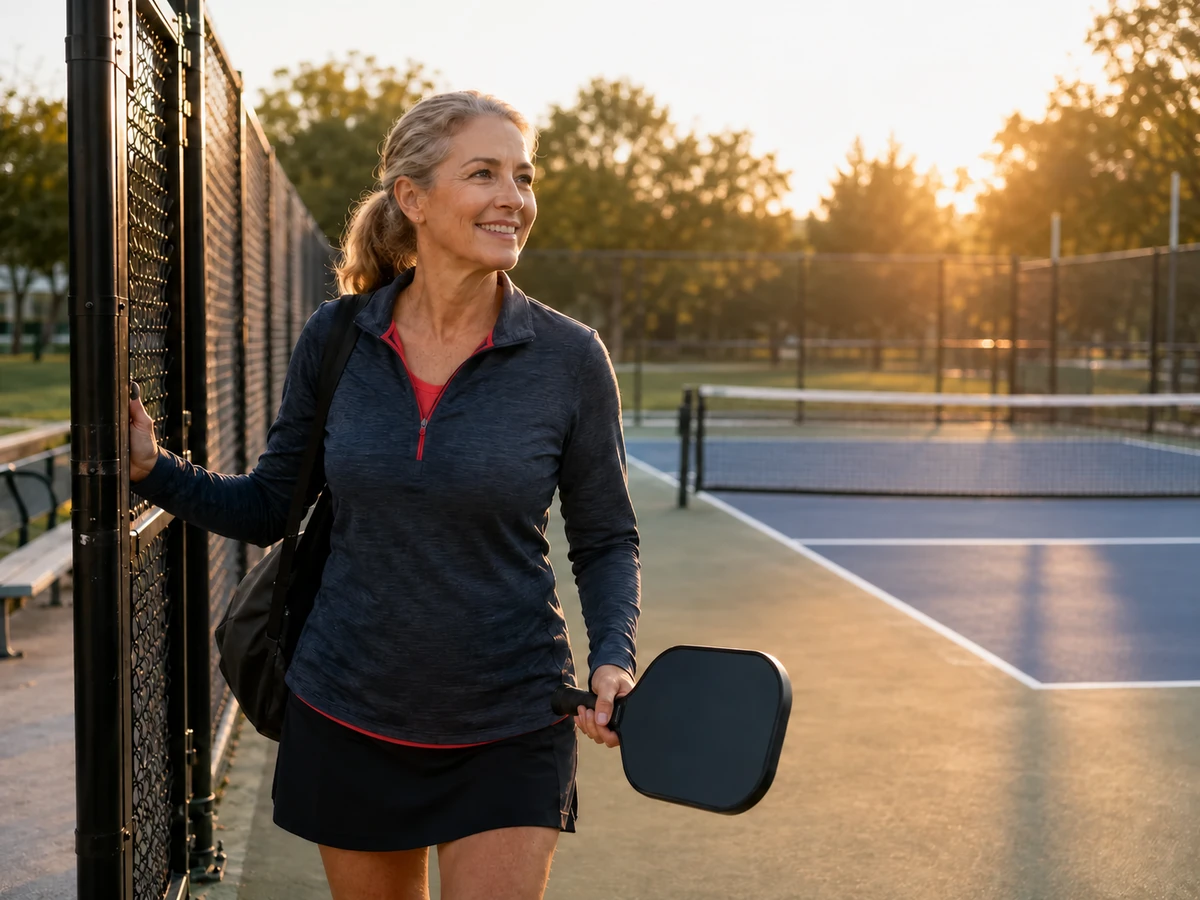
The short answer: 52 is not too late. The better question is whether you can begin at a pace that makes learning enjoyable, sustainable and safe.
At 52, the hardest part of starting pickleball may happen before anyone serves a ball. It is the private argument that says you have missed your window: other players are fitter, quicker or already fluent in the strange language of dinks, drives and the kitchen.
That argument feels convincing because adults rarely enjoy being beginners. We are accustomed to competence in the rest of life. On court, the score makes uncertainty visible. Yet that is also why starting can feel so rewarding. A new sport gives progress a shape you can see: one more return in play, one better decision, one rally that lasts longer than it did last week.
Accessible does not mean effortless
Pickleball is often described as easy to learn. The court is smaller than a tennis court, the serve begins underhand, and beginners can usually exchange balls before they understand every tactical detail. Those features lower the entry barrier; they do not remove the physical demands.
Players still accelerate, stop, reach, rotate and change direction. The ball may be light, but a competitive rally can become quick. A sensible beginning therefore combines curiosity with restraint: learn the rules, warm up, wear court shoes, and let consistency develop before chasing speed.
Why the sport can fit midlife
The appeal is not that pickleball somehow cancels aging. It is that the game can be scaled. Doubles reduces the ground each player covers. Recreational groups can adjust pace. A short session can still contain movement, coordination, decision-making and social interaction.
The broader health case starts with movement itself. The U.S. Centers for Disease Control and Prevention notes that regular physical activity supports heart and brain health, balance, sleep and independent living in older adults. Pickleball is one possible way to become active; it is not a substitute for medical advice or a complete fitness program.
Early pickleball research is encouraging but should not be oversold. A six-week feasibility study of inactive midlife and older adults reported strong adherence and improvements in several measured outcomes. More recent randomized trials have also reported gains in balance, gait, functional fitness and quality of life among selected groups of older adults. These studies are promising, but their samples and programs do not prove that every player will experience the same results.
The community may be the habit-forming advantage
Exercise plans often fail because they depend entirely on willpower. Pickleball adds appointments, partners and a reason to return. You are not only completing repetitions; you are learning names, remembering tendencies and sharing the small comedy of a ball that clips the tape and drops where nobody expected.
That social element matters. CDC guidance on social connection links supportive relationships with better health and well-being. A national cross-sectional survey of adults over 50 also found an association between current pickleball participation and lower perceived loneliness and social isolation. Because the survey was observational, it cannot prove that pickleball caused the difference; people who feel more connected may also be more likely to keep playing.
What your first month should actually accomplish
Week 1 – Learn the boundaries. Focus on the serve, return, non-volley zone and basic scoring. Finishing without pain is more important than winning.
Week 2 – Make contact repeatable. Shorten the swing, relax the grip and aim for a generous target rather than a spectacular winner.
Week 3 – Add positioning. Learn where to stand with a partner and recover after each shot. Many beginner points are lost before technique becomes the deciding factor.
Week 4 – Play with intention. Notice which balls you attack, which you defend and which mistakes repeat. One useful observation after a game is worth more than ten vague promises to play better.
Do not let equipment become the story
A beginner needs a legal paddle that feels comfortable, suitable court shoes, eye protection if desired, water and enough time to learn. A premium paddle may change feel, stability, spin potential or weight distribution. It cannot replace footwork, judgment or consistent contact.
Try equipment before upgrading when possible. Pay attention to total weight, balance, grip size and comfort rather than price alone. If you plan to compete, confirm that the model appears on the relevant event’s approved-equipment list. Racket Sports Times does not recommend turning a personal-growth story into an excuse for an unnecessary purchase.
Start intelligently, especially after a long break
If you have been inactive, have a chronic condition, are recovering from injury or experience chest pain, dizziness or unusual shortness of breath, seek appropriate medical guidance before continuing. Begin with shorter sessions and recovery days. Strength and balance work can support court movement, while a coach or introductory clinic can prevent avoidable habits.
Injury data also deserves honesty. Falls, strains and fractures occur in pickleball, particularly as participation grows among older players. The answer is not fear; it is preparation. Warm up, avoid backpedaling for overheads when safer positioning is available, respect fatigue and stop when movement quality deteriorates.
The real reward is becoming a beginner again
Starting at 52 is not powerful because 52 is old. It is powerful because adult life makes it easy to stop choosing experiences in which progress is uncertain. Pickleball offers a manageable way back into that uncertainty.
You may never become the strongest player at open play. You can still become calmer under pressure, more reliable with a partner and more capable than the person who first stepped onto the court. A rating can measure results. It cannot measure the courage required to begin, the friendships built between games or the satisfaction of learning something that once felt out of reach.
At 52, the best decision may not be to become a pickleball player. It may simply be to give yourself permission to try.
Frequently asked questions
Is 52 too old to start pickleball?
No. Many adults begin later. Readiness depends more on health, mobility, appropriate pacing and access to suitable instruction than on a particular birthday.
How often should a beginner play?
There is no universal schedule. Two shorter sessions with recovery between them may be more sustainable than playing hard on several consecutive days. Increase duration and intensity gradually.
Do I need an expensive paddle?
No. Comfort, legal dimensions, manageable weight and an appropriate grip matter more at the beginning. Technique and decision-making will shape improvement more than price.
Is pickleball safe for older beginners?
It can be an enjoyable form of activity, but no sport is risk-free. Appropriate footwear, warm-up, gradual progression, recovery and medical guidance when needed can reduce avoidable risk.
Sources and editorial note
CDC: Physical Activity Benefits for Adults 65 or Older
Pickleball for Inactive Mid-Life and Older Adults: A Feasibility Study
Association of Pickleball Participation With Decreased Perceived Loneliness and Social Isolation
Non-fatal Senior Pickleball and Tennis-related Injuries Treated in U.S. Emergency Departments
Editorial note: This article is an evidence-informed guide, not a first-person memoir. It contains no paid product recommendation or affiliate offer. Health information is general and is not medical advice.
Before buying your first premium paddle, read whether expensive pickleball paddles make you better. As you find a playing group, consider the balance between social and competitive play.

[…] For more on keeping competition in perspective, read what a player rating can and cannot tell you. New to the court? Explore starting pickleball in midlife. […]