
Pickleball manufacturers have reinvented what goes inside a paddle. Now some are beginning to question the shape of the paddle itself.
Pick up a premium pickleball paddle today and there’s a surprising amount of engineering hidden beneath the surface.
Carbon-fiber layups. Polymer cores. Perimeter foam. Thermoforming. New bonding methods. Different core densities and thicknesses. Manufacturers have spent years changing almost everything they can inside a paddle.
Yet put twenty of those paddles against a wall and step back.
Most still share essentially the same idea: a solid hitting surface attached to a handle.
That isn’t necessarily a problem. Familiar shapes survive for good reasons. But it raises an interesting question.
If manufacturers are willing to reconsider materials, cores, construction methods and weight distribution in pursuit of performance, why should paddle geometry remain largely fixed?
A small group of manufacturers has already started asking that question.
Selkirk experimented publicly with an open-throat paddle several years ago. More recently, the company collaborated with Tesla on a paddle developed with explicit attention to airflow and geometry.
Then, on March 5, 2026, USA Pickleball approved something considerably harder to categorize: KOBO’s THUNDER INFINITY, the certified model behind the commercially sold THUNDER AXE Infinity.
USA Pickleball’s own description of its shape is unusually direct:
“Custom Irregular with 3 air channels.”
That description points to another direction in paddle development: changing the geometry players can see.
After changing the inside, manufacturers are looking outside
The experimentation is happening while pickleball itself continues to expand.
The Sports & Fitness Industry Association’s announcement of its 2026 Pickleball Single Sport Report, released June 4, says 24.3 million Americans played pickleball in 2025, compared with 4.2 million in 2020.
The number of CORE participants—those playing at least eight times annually—grew from 1.4 million to 7.5 million over the same period.
A larger population of frequent players creates a larger audience for specialized equipment—and stronger incentives for manufacturers to find genuine differences between products.
For much of pickleball’s recent equipment boom, those differences have been largely internal.
Geometry offers another variable. And unlike a new core formulation, players can see it immediately.
The first opening
KOBO wasn’t the first company to question the solid-paddle convention.
Selkirk LABS introduced Project 002 in 2022, incorporating what the company calls an Air Dynamic Throat—an opening where the paddle face transitions into the handle.
Selkirk’s explanation traces that opening from Project 002 into the VANGUARD Power Air. The company describes it as a way to improve airflow and reduce drag; those benefits are manufacturer claims, not independent performance findings.
The engineering rationale can also be found in the patent record.
A Selkirk-assigned patent application, with priority dating to December 2021, describes a pickleball paddle with an opening through the lower portion of the head and discusses reduced air resistance as one potential benefit.
A patent isn’t proof of a performance advantage. It describes an invention and its proposed functions.
It documents an engineering rationale for the opening beyond appearance.
Paddle designers were beginning to treat airflow and external geometry as engineering variables.
There is physics behind the idea
The concept isn’t unique to pickleball.
Research published in the Proceedings of the Institution of Mechanical Engineers, Part P: Journal of Sports Engineering and Technology examined airflow around paddle-type racquets containing aerodynamic openings.
In Some observations on the flow physics of paddle racquets, mechanical engineer Francisco J. Huera-Huarte studied how the presence and distribution of those openings affected aerodynamic drag and the wake behind the racquet.
That research was not conducted on a KOBO paddle, nor was it a comparison of today’s pickleball equipment.
It therefore cannot tell us that a particular pickleball paddle is faster simply because it has an opening.
What it does tell us is more useful: openings can alter airflow around a paddle-type structure, and their size, position and distribution matter.
That turns paddle geometry into a legitimate engineering question rather than merely a visual one.
When Tesla starts looking at paddle airflow
That question gained an unusual participant in late 2025.
Selkirk announced that it had worked with Tesla on the Tesla Plaid Pickleball Paddle, with development involving airflow, drag, wake behavior and paddle geometry.
The resulting design incorporated an open throat, elongated profile and edgeless construction.
Those development details come from Selkirk and should be understood as manufacturer-reported information rather than independent scientific validation.
But the collaboration is significant for a different reason.
By this point, paddle aerodynamics was no longer merely an unusual hole in an experimental paddle. A major pickleball manufacturer and an automotive engineering company were explicitly treating shape and airflow as part of paddle development.
Then KOBO pushed the visual idea much further.
From one opening to three air channels
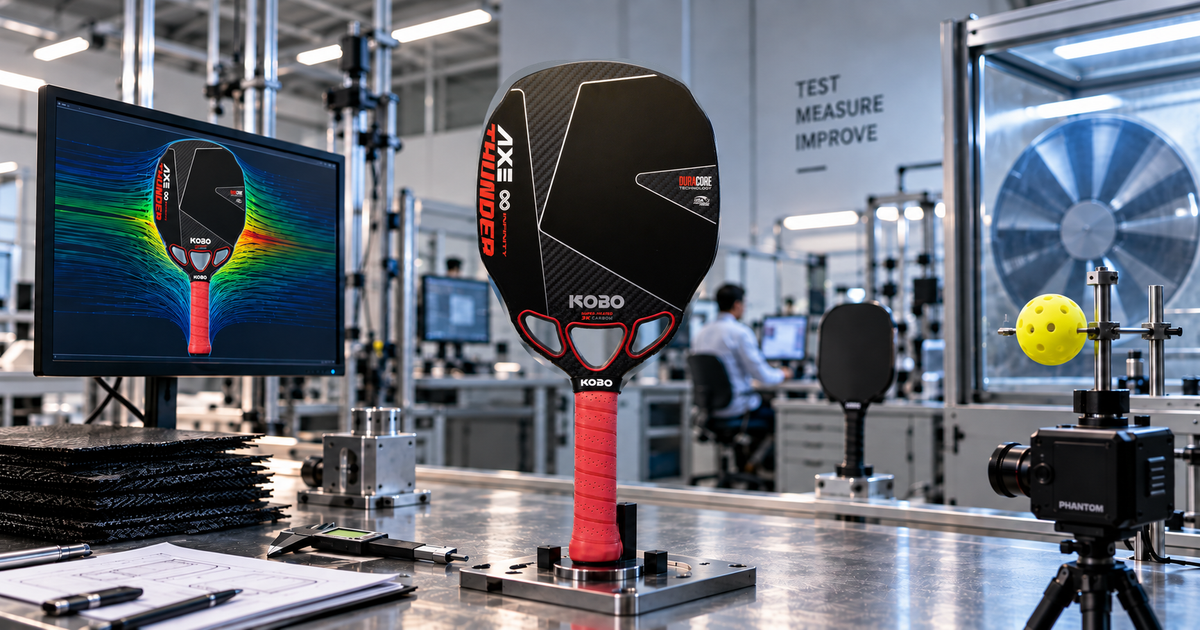
The KOBO THUNDER AXE Infinity 18mm is difficult to mistake for a conventional paddle.
Instead of placing one opening in the throat, KOBO incorporated three separate air channels across the lower paddle geometry.
The openings aren’t hidden. They define the design.
And we don’t have to rely on KOBO’s marketing language to establish how unusual the shape is.
USA Pickleball’s THUNDER INFINITY certification record identifies the submitted model as THUNDER INFINITY and records:
Status: Pass
Added: March 5, 2026
Depth: 18mm
Shape: An irregular design with three air channels
The shape entry is the important detail: the three channels are explicitly documented in the certification record.
The commercial version is sold as the THUNDER AXE Infinity.
With it, KOBO isn’t simply changing the material inside a familiar paddle outline. The company is making the outline itself part of the engineering proposition.
What are those three channels actually doing?
This is where we need to separate an interesting design from a proven performance claim.
KOBO says the three channels are designed to reduce aerodynamic resistance as the paddle moves through the air.
There is scientific precedent for the broader principle that openings can alter airflow around paddle-type structures. There is patent history around open-throat pickleball paddles. And other manufacturers are now explicitly exploring paddle aerodynamics.
But none of that independently proves the performance of this particular three-channel geometry.
The sources reviewed for this article do not provide an independent wind-tunnel or computational fluid-dynamics comparison between the THUNDER AXE and an equivalent conventional solid pickleball paddle. Computational fluid dynamics uses computer simulations to study airflow.
So we cannot independently say how much drag the channels reduce—or whether any measured aerodynamic difference produces a meaningful increase in swing speed on court.
The design deserves testing. The question is whether this particular arrangement of openings produces a measurable advantage without creating larger disadvantages elsewhere.
Aerodynamics is only one part of paddle engineering.
Remove material and you may also change mass distribution, stability, structural behavior and the effective hitting area.
Engineering rarely gives something for nothing.
The court provides another kind of evidence
Laboratory measurements aren’t the only way to evaluate an unconventional paddle. Players still have to use it.
Reviewer Taylor Gervais at Pickleheads gave the THUNDER AXE 4.0 out of 5 overall, praising its control and spin while identifying power, forgiveness and price as compromises.
Perhaps more relevant to the geometry discussion, Gervais reported that the paddle moved surprisingly quickly despite feeling head-heavy.
The review includes affiliate links and a discount code. Its playing impressions are useful observational evidence, but they are not aerodynamic measurements.
A player reporting that a paddle feels fast doesn’t tell us exactly why it feels fast. Weight, balance, swingweight, geometry and individual technique can all influence perception.
The Dink also covered the paddle shortly after its approval, focusing on its unconventional geometry and the extent to which the design departs from a traditional paddle.
That reaction may itself tell us something.
The THUNDER AXE attracts attention because you don’t need to understand paddle-core construction to see that someone has changed the architecture.
What we’d like to see next
The next step shouldn’t be another adjective. It should be a controlled test.
Take a conventional solid paddle, a single open-throat paddle and a three-channel paddle.
Control mass and swingweight as closely as practical.
Measure aerodynamic drag at different orientations and representative swing velocities.
Visualize how air moves around and through each geometry.
Then put those paddles into players’ hands and ask whether measurable differences correspond with what players actually perceive.
Such a test could produce several outcomes.
Three channels might generate a meaningful aerodynamic difference.
A single throat opening might capture most of the benefit.
The effect might be measurable but too small for most players to notice.
Or the testing could reveal tradeoffs that aren’t obvious from looking at the paddles.
Any of those results would advance the discussion.
And they would be considerably more useful than deciding which paddle looks fastest.
The rules will shape what comes next
There is another limit to paddle experimentation: manufacturers cannot simply remove material wherever they choose.
USA Pickleball’s Equipment Standards Manual, section 2.E, sets requirements for paddle construction and the hitting surface. Its restriction on holes in the hitting surface makes the location of an opening important.
The certification process therefore matters as manufacturers push geometry further. Approval establishes equipment compliance; it does not establish an aerodynamic advantage or endorse a manufacturer’s performance claims.
That is part of what makes the THUNDER INFINITY record interesting.
This isn’t merely a concept paddle.
USA Pickleball evaluated the submitted design, explicitly recorded its unusual three-channel geometry and gave it a Pass status.
The boundaries of legal paddle geometry are therefore being explored in actual commercial equipment—not just sketches and prototypes.
Pickleball’s next technology race may be visible from across the court
None of this means the traditional solid paddle is disappearing.
There are good engineering reasons for conventional geometry: hitting area, predictable mass distribution, structural simplicity and familiarity.
And unusual doesn’t automatically mean better.
Some experiments become the future. Others become footnotes.
But there is now enough evidence to see a progression.
An experimental open throat appeared.
The concept moved into commercial paddles.
Patent literature documented the engineering thinking behind it.
Researchers had already demonstrated that openings can alter airflow around paddle-type racquets.
Aerodynamics became an explicit development consideration in the Selkirk–Tesla project.
KOBO’s three-channel design adds another example to that progression.
That doesn’t tell us where paddle design ends up.
It tells us that one of the sport’s longest-standing assumptions is finally open for experimentation.
For years, manufacturers asked:
What else can we put inside a pickleball paddle?
The next generation may be asking a very different question:
How much of the paddle needs to be there in the first place?
Editorial Note
This article examines the development of unconventional pickleball paddle geometry using USA Pickleball equipment records, published engineering research, patent literature, manufacturer development records and published equipment reviews. Manufacturer performance claims are identified as such and are not presented as independently verified findings unless supporting evidence is available.
Disclosure
Racket Sports Times is owned by KOBO Sports LLC, whose paddle is discussed in this article.

[…] a closer look at equipment innovation, read why manufacturers are reconsidering pickleball paddle shape. New players can also explore our guide to starting pickleball in […]