
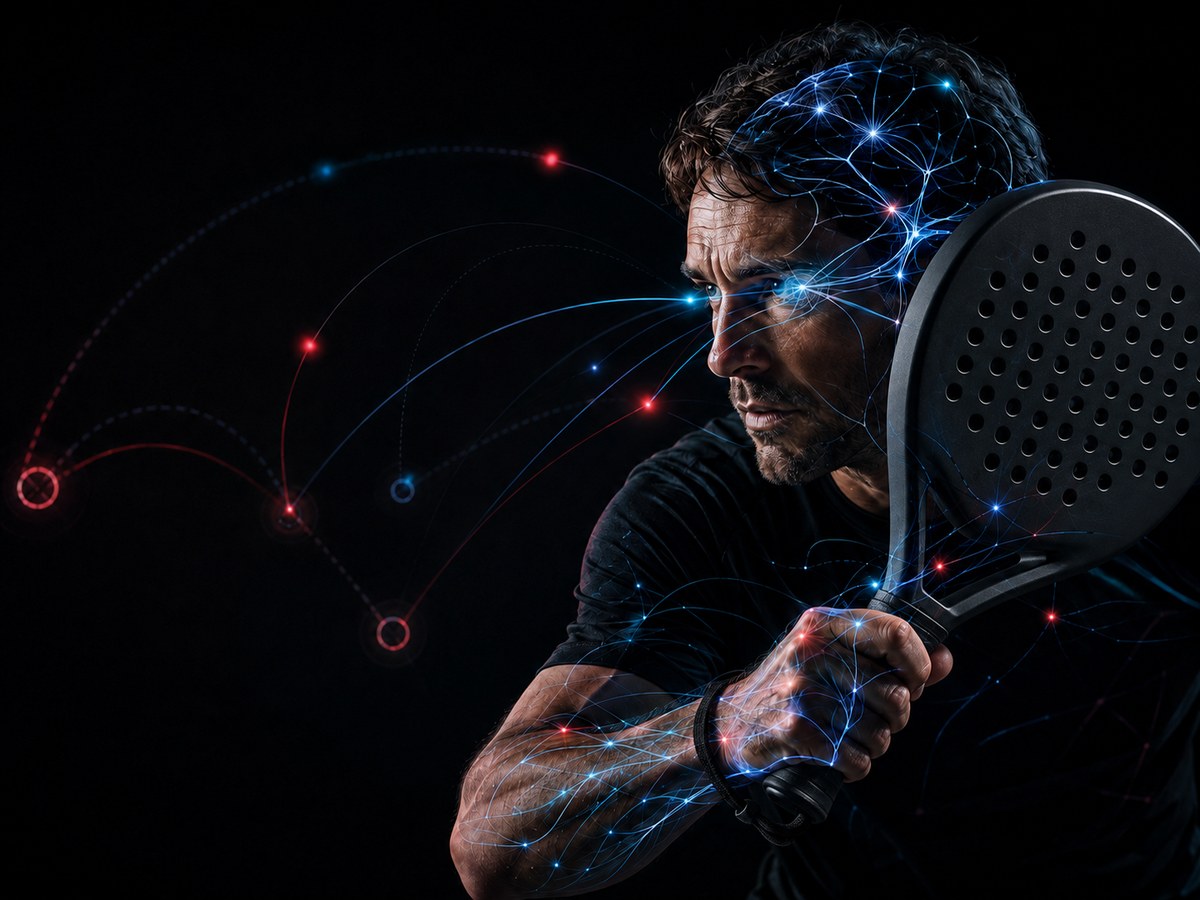
A racket-sports rating can tell you what happened in competition. It cannot fully explain how you read the game, make decisions or develop your next level of skill.
The score is close. Your opponent begins preparing for the next shot, and you move before the ball crosses the net.
To someone watching, it may look like quick reflexes. But your brain has already been working. It noticed the opponent’s position, recognized the shape of the swing, compared the moment with patterns stored from previous rallies and selected a response—all within a fraction of a second.
If the shot works, the result may eventually influence your player rating. None of the thinking behind it appears in the number.
That is the important difference between a rating and a player: the rating records the outcome, while the player creates it.
What does a player rating really measure?
A rating is useful because it creates order from competitive results. It helps tournament directors place players in appropriate divisions, gives clubs a way to arrange balanced games and allows competitors to follow changes in their performance.
In pickleball, USA Pickleball describes a player rating as a snapshot of current ability based on verified play. DUPR considers factors such as performance against expectations, match type, recency and the number of recorded results.
These systems answer an important question: How has this player performed against other rated players?
They do not directly measure anticipation, confidence, concentration, tactical creativity or learning potential. Those qualities can affect match results, but the rating does not examine them separately.
That is why two players with identical ratings can feel completely different across the net. One may build points patiently and rarely miss. Another may win through speed and aggressive attacks. A third may see the correct tactical option but still be developing the technique required to execute it consistently.
The number can place them at a similar competitive level. It cannot tell their entire stories.
The fastest reaction may begin before the shot
Racket sports are often described as tests of reaction time. That is only part of the picture.
Experienced players do not always wait to see where the ball is going. They learn to collect information before contact. The opponent’s balance, court position, shoulder rotation, racket preparation and previous choices can all provide clues. Together, those details allow a trained player to anticipate what is likely to happen next.
Research reviewing expert performance in striking sports found that skilled athletes use visual information differently from novices when anticipating fast-moving objects. A recent systematic review and meta-analysis also found a strong expert advantage in sport-specific anticipation.
That advantage does not necessarily mean experts have universally faster brains. It is often built from knowledge developed inside the sport.
A tennis returner learns to read elements of a server’s motion. A table-tennis player identifies possible spin from the angle and speed of the racket. A pickleball player recognizes when an opponent’s preparation makes a speed-up more likely.
The beginner sees a shot. The experienced player begins to see the information that comes before it.
Seeing the answer is not enough
Anticipation creates time, but the player must still decide what to do with it. Should you attack, reset or defend? Play into open space or directly at the opponent? Attempt the difficult winner or extend the rally?
Then comes another challenge: can your body execute the decision?
A systematic review of tennis performance found differences between playing levels in technical abilities, including ball speed and accuracy, and tactical abilities such as anticipation, decision-making, tactical knowledge and visual-search strategies.
These abilities operate together. Perfect technique cannot rescue a poor tactical choice. A brilliant decision cannot win the point if the player cannot execute the required shot.
Practice is teaching the brain what to notice
Training changes more than muscles and mechanics.
Research into neuroplasticity and motor-skill learning describes functional and structural changes associated with acquiring, consolidating and retaining motor skills.
When learning a new stroke, a player may consciously monitor the grip, preparation, swing path and contact point. With effective practice, parts of the action become more automatic. More attention becomes available for the ball, the opponent and the developing point.
This also explains why improvement is not always immediately reflected in a rating. A stronger tactical understanding may exist before the necessary execution becomes reliable. Performance can fluctuate while an old habit is being replaced.
Better attention can produce better movement
A systematic review of attentional focus in racket sports found that directing attention toward the intended effect of a movement generally supported motor learning and performance better than focusing excessively on individual body movements, particularly for novice and lower-skilled players.
“Send the ball high over the net” is an external target. “Rotate your shoulder, position your elbow and move your wrist” directs attention internally.
Technical instruction is still necessary. But during execution, trying to control several body parts at once can make a movement less natural. Good coaching helps the player direct attention toward information that matters at the right moment.
Can cognitive ability predict your future rating?
The honest answer is: not reliably.
A major meta-analysis examining cognition and sports performance found that higher-skilled athletes generally performed better on cognitive assessments. The largest differences appeared in sport-specific decision-making tasks rather than general cognitive tests.
However, the researchers found insufficient evidence that cognitive testing could predict future sports performance. They cautioned against using general tests of executive function for player selection or talent identification.
Sport may help develop certain cognitive abilities. People who already possess useful abilities may also remain in a sport longer. Coaching, conditioning, motivation, opportunity and experience further complicate the relationship. A laboratory test cannot tell you how good a racket-sports player you will become.
Train recognition, decisions and execution together
Players do not need to “make their brains faster.” They need to improve the connection between what they see, what they decide and what they can execute.
- Face realistic and varied shots instead of relying only on predictable feeds.
- Watch an opponent’s preparation and position.
- Use drills that require a choice between several responses.
- Review recurring patterns after matches.
- Practise with scores, targets and controlled pressure.
- Use simple external-focus cues.
- Develop technique until common movements require less conscious control.
- Protect sleep and recovery so learning has time to consolidate.
The objective is not merely to react faster. It is to recognize the right information earlier.
A rating is a photograph, not the whole film
Your rating has value. It can help you find appropriate competition, enter the right division and observe changes over time.
But it remains a photograph of demonstrated performance—a moment captured from a much longer process. It does not show the pattern you have only recently learned to recognize, the new stroke that is not yet dependable under pressure or the tactical lesson that will influence your next hundred matches.
Most of all, it does not measure your intelligence, your worth or the limit of your potential.
Respect the number, but do not become trapped inside it.
A better question than “What is my rating?” may be: What am I learning to see, decide and execute today that I could not do yesterday?
Frequently asked questions
Does a higher rating mean a player has faster reflexes?
Not necessarily. Higher-level players often anticipate shots sooner because they recognize sport-specific information and familiar patterns.
Can brain-training games improve a racket-sports rating?
There is insufficient evidence that general brain-training games reliably improve competitive racket-sports performance. Practice combining realistic visual information, decisions and physical execution is more directly relevant.
Why is my rating unchanged when I feel that I am improving?
New skills may take time to become consistent in competition. Ratings also depend on recorded opponents and match results, so development can occur before it becomes visible in the number.
Can players learn anticipation?
Evidence indicates that sport-specific anticipation improves with experience, and targeted training may help when it resembles real playing situations.
If a rating is changing how you enjoy the game, explore social and competitive motivations in racket sports. For another perspective on improvement, read what equipment can and cannot do for your game.

[…] more on keeping competition in perspective, read what a player rating can and cannot tell you. New to the court? Explore starting pickleball in […]